24 Apr 2023

GardenWatch: April in the Veg Patch

After a winter that seemed to go on for ever, I've barely started sowing and it already feels like the summer solstice is drawing near! Let's see what's happening in the garden...

Yep, it's blossom time again. The pear trees never fail.


Now that we're half way through the spring months, the air temperature is warmer making it a real pleasure to potter around the garden as the plants put on some very vigorous growth.  I have two garden spaces that I look after here in my urban Eden - the veg garden which is languishing while waiting for sowing and planting to begin, while the car park garden is verdant with colour and greenery from the hedges, perennials, bi-annuals and spring bulbs. 

Pretty little spring veg patch

But it's not quite true to say that the veg garden languishes ... flowers to encourage early pollinators have been blooming - daffodils, violets, forget-me-nots, tulips ... while on the food front, late summer planted purple sprouting broccoli is doing me proud with regular pickings of delicious sprouts and there's also some chard that has stood over the winter.  The PSB was planted out so late that I honestly didn't expect the plants to produce anything. They didn't have time to grow to their full stature before winter so to see heads forming and sprouts shooting up this month was genuinely and unexpectedly thrilling. 

And then there's my expanding patch of wild garlic leaves - so delicious in a risotto or used to make pesto.  I bought one plant almost a decade ago from Jekka McVicar's herb farm that now covers a metre and a half under the fruit trees. As it's away from pollution and organically grown, I can harvest without worry.  Am I concerned about it taking over? No. Besides, is there such a thing as Too Much Wild Garlic?  For now, there's little landing space for any seeds as the wild garlic is growing through Cerinthe (Honeywort), Ajuga and leaves of Hemerocallis (Day lilies). 

PSB, rhubarb, gooseberry flowering;
Sweet Cicely, Wild Garlic, Sweet Woodruff (all edible!)

A rare week of warm weather interspersed with heavy rain has done the garden (and me) the world of good; the fruit trees are a riot of blossom (until spring storms blow it all away), rivers of Sweet Woodruff and Sweet Cicely are about to flower, ever dependable rhubarb has appeared, honeyberry and gooseberry bushes are flowering. I'm keeping my fingers crossed for plums, as usual. 


Where I'm at with seed sowing ...

So while there are a few plants to pick from, I have to confess that I neglected to grow many other veg that could be filling the hungry gap at the moment. To remedy that, I've just sown kales, butternut squashes, leeks and Chioggia pumpkins indoors.  

As ever, I long for a greenhouse. It wouldn't be empty for long if my tiny balcony is anything to go by.  Currently filling every nook and cranny are trays of beetroots,  nasturtiums, courgettes, spring onions, salad leaves, tomatoes, lamb's lettuce, beans, and pollinator friendly annuals of cosmos, calendula, gypsophila, verbena, sweet peas and echinacea.  If I can find space for them, I also want to grow Bunny Tail grass for some winter wreaths. 

I'm keeping veg sown into modules in the shelter of my balcony for now but outside the soil is warm enough to sow some veg (and flowers!) direct ... at least in the south of the UK. In the past week, broad beans have gone into the soil, garlic and onions that were overwintered in modules have been planted, the Jerusalem artichoke hedge is in, and peas, radishes and carrots will be next. 

Spring has truly arrived with all its thrilling moments!  


31 Mar 2023

Revisiting an immune boosting tea from the herb garden


And, finally, there was tea ...


It's probably a bit early for all the herbs in this tea to be available in the garden but as many of my friends and family have colds at the moment, it seems timely to revisit this delicious tea.  

Some readers may remember this tea ... I initially wrote this as part of a look back at May 2020 in the garden - a time when we needed all the immune support we could get! So, if these plants are not flourishing in your garden yet (take heart, it won't be long), bookmark this post to come back to it.  And while the plants are available, pick and dry some of the leaves to store for winter colds. 

And if you don't already grow these plants, can I suggest that all of these are well worth growing?  Lemon balm is so easy to grow, loves shade and still it tends to self seed vigorously.  I now also grow Lemon Verbena - it's a glorious herb, and I keep the lemon balm shorn to a more manageable blob. 

Five herbs to steep in a teapot for a delicious immune boosting herb tea - achillea, calendula, mint, lemon balm, thyme.

An Australian permaculture channel posted a video for what they call 'Immune-i-Tea' ... a delicious immune boosting drink made from garden herbs.  To my delight, I found that I had all of the necessaries in my herb garden.

Just five herbs needed in roughly equal quantities, a small handful of each of yarrow (achillea), calendula flowers, mint, thyme and lemon balm.  Put into a large teapot, cover with boiling water and put the lid on.  Leave for at least 10 minutes and then pour.  It was surprisingly thirst quenching, tasty and uplifting and, I imagine, would also be lovely chilled. I think I may never buy another herbal tea bag.

20 Feb 2023

The How and Why of growing Jerusalem Artichokes

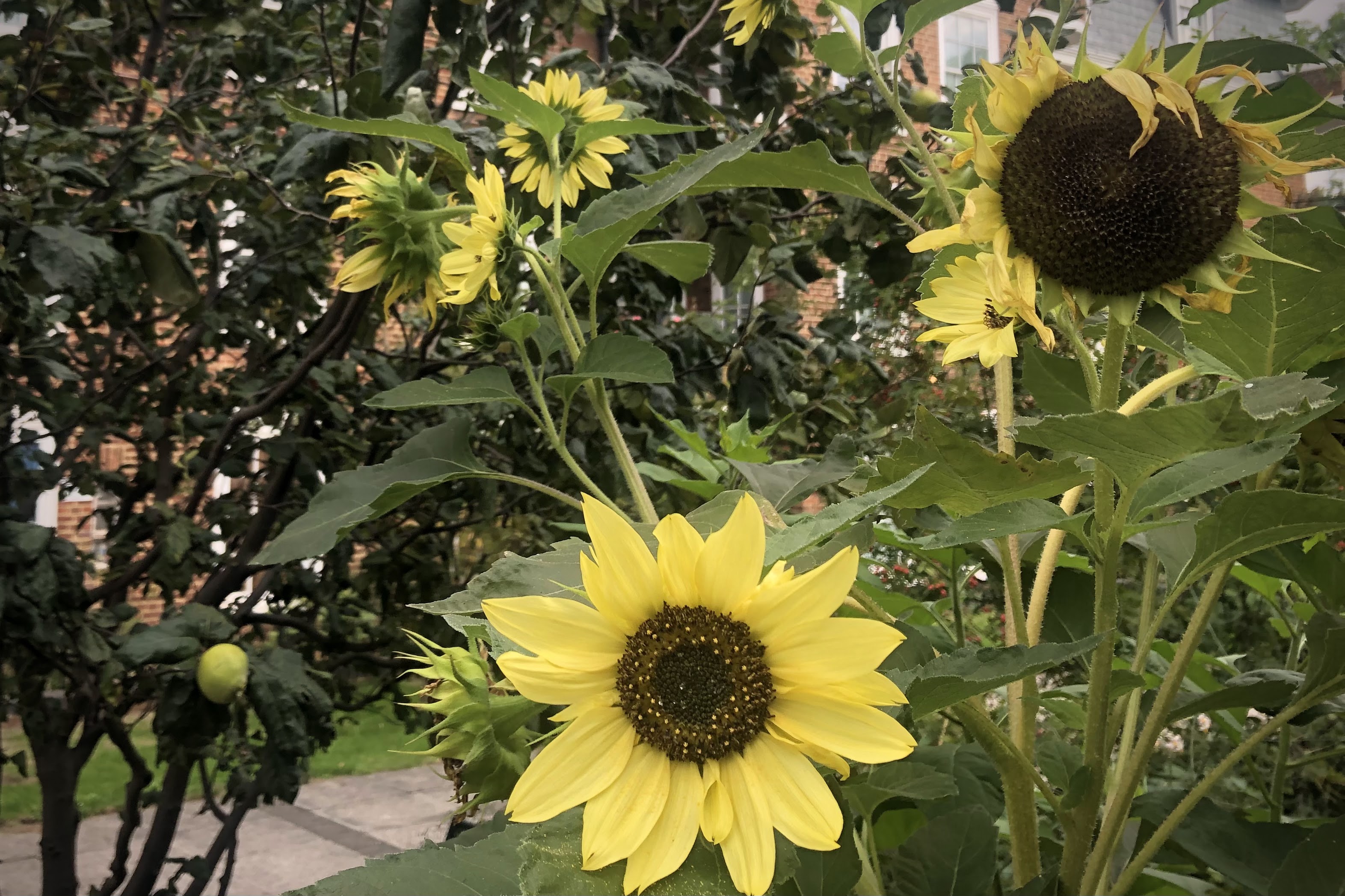
Spot the real sunflower - most of these are Sunchokes (Helianthus tuberosus)

My new discovery for the veg patch last year was Jerusalem Artichokes, also known as Sunchokes. I grew them for the sunflowers, little knowing of their many health benefits!

I'd resisted growing Jerusalem artichokes until the day they were served up as a side veg at a particularly posh restaurant meal that I was invited to attend. First tastes didn't provoke a eureka moment but that smooth blob of puréed sun-chokes piqued my curiosity. Was this a useful addition to the veg patch? And was their reputation for causing flatulence justified? 

There were two important things that started my growing experiment:  

One, the plants are in the same plant family as sunflowers;  so it's a double win for the veg garden to get cheerful pollinator attracting sunflowers and, of course, those edible tubers after the flowers have faded. Plus seedheads in the autumn for birds to munch on. Triple win! 

Secondly, I read that specialist tubers are not obligatory so I grabbed a bag of Jerusalem artichokes from the veg aisle in my local supermarket to start the experiment - and, even better, they were at sale price being at their 'best before' date.  

Sunchoke leaves are less serrated than regular sunflower leaves.

Growing them is easy: 

I dug a foot wide shallow trench in a sunny corner of the veg patch, forked in some compost from my Hotbin (although any compost would do), buried the tubers about 4 inches deep, spaced them 8 inches apart, then covered them over again with soil. Job done. And then watered and waited. Probably longer than was necessary but the tubers can be left in the ground until needed. Just wait until the flowers have finished. So simple. 

They didn't need earthing up like potatoes, they didn't need staking like tall sunflowers - unless your site is very windy - plus they're fairly pest resistant. And each tuber planted produced around 10 to15 more which I have roasted, pureed and mashed. Deliciously nutty, but their gassy reputation is warranted in my case. Enough said.

But not to be put off by their wind producing side effects, this year I'm bordering the veg patch with an extended row of Jerusalem Artichokes. Why? because they have some very good health benefits.

A harvest of home grown winter vegetables
Harvesting Jerusalem artichokes from October through to January! 

So let's talk health benefits ...

These tubers are allegedly a nutritional powerhouse.  They're a good source of antioxidants which makes them gut-friendly and immune-boosting. They're also packed with fibre, iron, potassium and phosphorus. (Huh? I had to find out what phosphorus is in relation to the human body, rather than soil!  It's a mineral that supports the formation of bones and teeth, repairs cells, normalises the heartbeat, kidney function and muscle contractions. So .. pretty important stuff.)

But what they're most famous for is their high inulin content. Inulin is a carbohydrate that acts as a prebiotic, feeding your good gut bacteria to keep your innards healthy.  It's hard to digest so when it reaches the intestines, it feeds the gut bacteria which then produce methane gas ... yes, the source of their nickname, fartichokes. 

That aside, Jerusalem artichokes are touted as a good substitute for potatoes being low carb, low sugar and full of fibre. 

They're still a bit of a novelty for me and I now know to eat them as a treat rather than every day and certainly not in any great quantity as I could feel (and hear!) the effect they had on my intestines for a couple of days. 

There is a way to lessen the gassiness ...

I've read that there are three ways to reduce the side effects of Jerusalem artichokes.  The first is to gradually increase the amount eaten in order to get your body to adapt; the second is to boil the sliced tubers in lemon juice which turns the inulin into fructose thereby making them sweeter but less gassy. The third is to slice and pickle them, retaining the nutty flavour and crunch.  Option 3 sounds interesting!

So, a potato substitute with health benefits and cheerful flowers ... will you give them a go this year?

A few of the ultra-delicious recipes I've tried!

If you're new to cooking Jerusalem artichokes, can I steer you in the direction of Riverford Organic Farmers website?  Here you'll find not only a few of the recipes that inspired me but also some good advice on preparing the tubers if you watch the video in the first recipe listed below.

Roasted Jerusalem artichokes with mushrooms, rosemary and garlic - still my favourite

Jerusalem artichoke and bacon gratin - cheese, bacon, cream and sunchokes, delicious.

Jerusalem artichoke and leek soup - the perfect soup using available veg from the winter garden. 

Happy munching! 

And here's Charles Dowding showing how he grows his Jerusalem Artichokes:

https://youtu.be/jIM2mxswJZ8